Category: Right of Slider
Network Catalyst Teams Convene Diverse Stakeholders from Across Virginia in Workshops on Emergency Preparedness and Extreme Heat
Through our Network Catalyst Grants Program, the ISE supports the development of transdisciplinary faculty-led teams in applied research aligned with the UN Sustainable Development Goals in order to accelerate transdisciplinary engagement on critical issues from an impact-driven, co-creative research perspective. Network Catalyst teams work with the Institute to forge new and sustained engagements, and/or evolve and activate existing partnerships with community-based organizations, NGOs, governments, the private sector, or other strategic partners working toward shared visions and actions. This summer, our 2024-2025 Network Catalyst Teams held workshops to bring together these different stakeholder groups around the themes of extreme heat and emergency preparedness.
Network Catalyst Workshop on Emergency Preparedness
The ISE Network Catalyst Grant team on Emergency Preparedness co-organized a workshop on Resilient Communication and Sheltering during Emergency Evacuations at Virginia Beach City Hall on July 11, 2025. This workshop was co-organized by project members Dr. Hemant Purohit (Information Sciences & Technology, CEC), Dr. Qian Hu (Schar), and grad student researcher Yasas Wijesuriya (PhD program in Information Technology, CEC) from George Mason University, and Dr. Joshua Behr from Old Dominion University, in partnership with officials from the City of Virginia Beach’s Department of Emergency Management (VB-DEM) and Division of Information Technology (VB-IT).
This collaborative initiative brought together researchers and practitioners and the workshop aimed to support the City’s Mitigation Action focused on developing a local hurricane evacuation framework and identifying communication networks for evacuation messaging.
It attracted a diverse group of leaders from over five agencies engaged in programs relevant to emergency evacuations, ranging from emergency communications to social services. Activities included a keynote address by the Director of VB-DEM, followed by two guided discussions on increasing voluntary evacuation propensities among at-risk populations. These discussions aimed to inform decision-making and enable tailored messaging during critical emergency events.
The project team is grateful to ISE to support this workshop and plans to continue this work with the Hampton Roads region broadly. It is being further supported in part by a new National Science Foundation grant from the Smart and Connected Communities program, led by Principal Investigator Dr. Purohit, in collaboration with VB-DEM and VB-IT.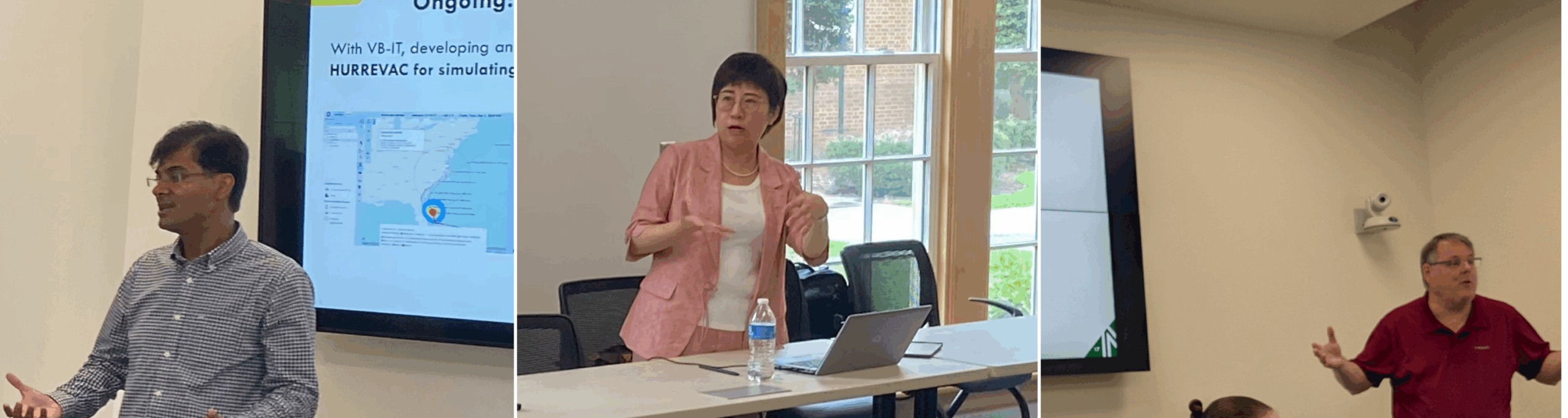
Left: Dr. Hemant Purohit summarized the vision of the ongoing collaborative work with the city.
Middle: Dr. Qian Hu facilitated guided discussion on processes for communication during evacuations.
Right: Dr. Joshua Behr presented findings from the literature on evacuation challenges.
Network Catalyst Workshop on Extreme Heat
The ISE Network Catalyst Grant team on Extreme Heat led a workshop on August 21st, 2025 titled “Extreme Heat in Virginia: Catalyzing a Multi-Sector Research Agenda” organized by GMU’s Dr. Luis Ortiz (AOES, COS), Dr. Fengxiu Zhang (Schar), Dr. MB (Marybeth) Mitcham (Global & Community Health, SPH), and Dr. David Wong (GGS, COS) with the support of GMU grad student researcher Noah Blanco-Alcalá (Climate Science MS, AOES). Recognizing that action on adapting and mitigating extreme heat is an “all hands on deck” problem, the workshop hosted a diverse group of researchers, practitioners, as well as municipal, state, and federal staff to identify the unique challenges in addressing extreme heat in Virginia. Attendees included staff from Alexandria, Arlington, Prince William County, Fairfax County, Fairfax City, Virginia Department of Emergency Management, Virginia Department of Environmental Quality, NOAA Climate Program Office, the American Red Cross, The Federation of American Scientists, and the Atlantic Council. Expertise from the invited group included energy and sustainability, health, emergency management, forestry, and nationwide and international advocacy. The objectives of the workshop included understanding existing practices in Virginia to tackle extreme heat at a range of spatial and temporal scales, identify key knowledge gaps that prevent action, and share current and future avenues for addressing those challenges, including new and existing partnership opportunities.
The team is currently exploring next steps, including a potential community of practice on extreme heat and a shared network of practitioners. In addition, the team is exploring funding mechanisms to fill identified knowledge gaps such as the NSF Infrastructure Systems and People and Translation-to-Practice programs.
The workshop was supported by the ISE Network Catalyst Grant and the Virginia Climate Center.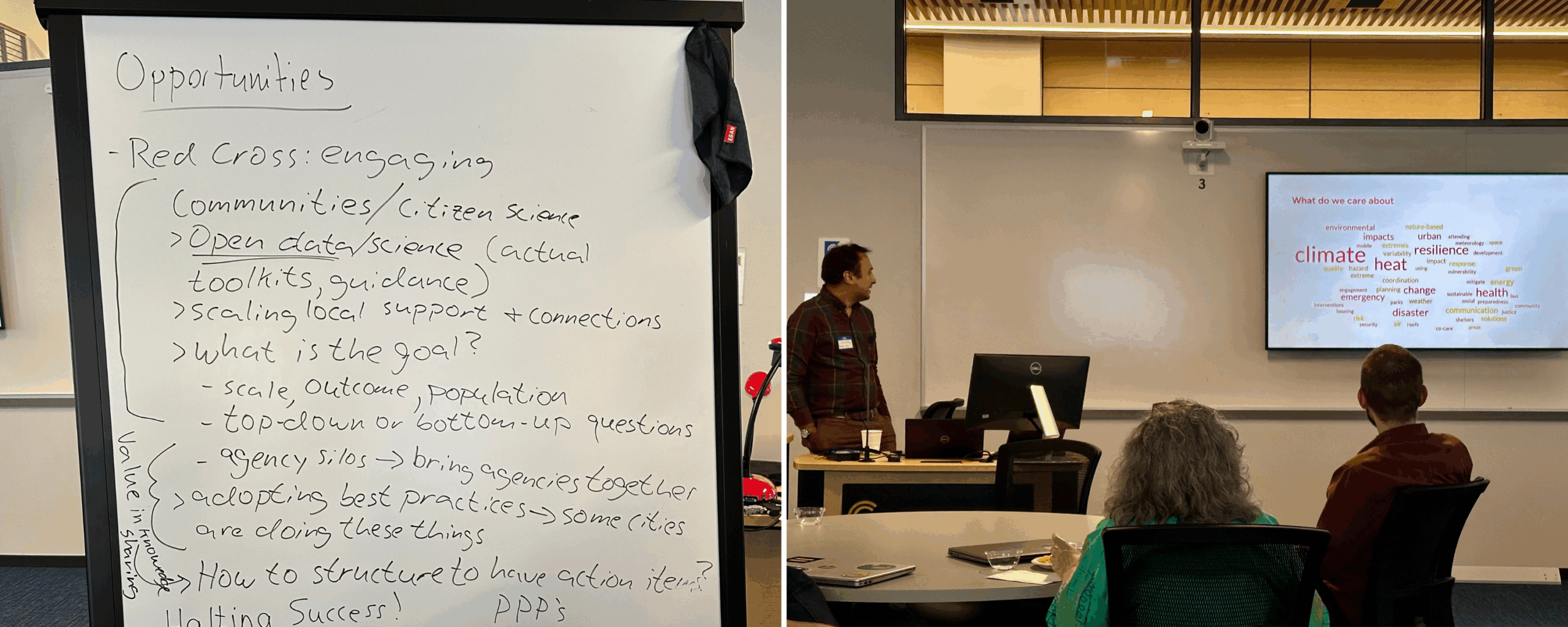 Right: Dr. Ortiz shares the pre-workshop responses to highlight the intersecting concerns and interests of participants.
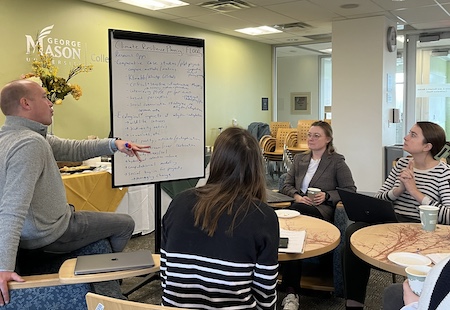
Left: Breakout groups discussed opportunities for partnerships and collaborative engagement around extreme heat in VA. This whiteboard captures just one of the breakout groups’ ideas.
For more information about the ISE Network Catalyst Grants program, contact ISE Associate Director Dr. Julianna Gwiszcz ([email protected]).